
Representation Without Rupture: Zohran Mamdani and the Politics of Empire


Zohran Mamdani has been sworn in as mayor of New York City. For many, the moment is framed as historic: a young, immigrant, Muslim mayor at the helm of the largest city in the United States. The American empire has long understood that diversity can stabilize legitimacy; that representation can renew faith in a system without altering its foundations.
The Critique of Assimilationist Politics
It should have been needless to say, but after watching so many people celebrating this win on the left, it must be stated that the rhetoric of “reclaiming” American identity and the embrace of American aesthetics do not challenge empire; they normalize assimilation into it. You cannot simultaneously demand inclusion within empire and pose as its negation. You cannot want to be seen as fully American, legible, respectable, invested in its national story while also claiming distance from the violence that story rests upon. These positions are mutually exclusive.
The Redirecting of Anger into Stabilizing Channels
Yes, Muslims and Black people suffer enormously under American imperial and racial order domestically and globally. That suffering is real, historic, and ongoing. But the political question is not whether oppression exists; it is what is done with the anger it generates. When that anger is redirected toward recognition, representation, and acceptance within the imperial framework, it becomes a force for stabilization rather than rupture. Empire welcomes this form of politics. It can accommodate diversity. It can absorb difference. What it cannot tolerate is a politics that refuses assimilation altogether , a politics that identifies empire itself as the source of violence and aims not to humanize it, but to end it.
The Function of controlled opposition
From Obama to Sanders to AOC to Zohran Mamdani, the cycle repeats with remarkable consistency. These figures do not arise spontaneously from ruptures in the system; they are cultivated within it to perform a specific political function: to absorb popular anger, demobilize resistance, and redirect revolutionary energy into safe, systemic channels. What appears as opposition is, in practice, regulation—dissent rendered manageable. This is why social democracy in the Global North functions as the left wing of fascism.
The Material Basis of Social Democracy in the Imperial Core
Many chauvinistic white leftists dismiss national liberation and anti-colonialism as secondary, abstract, or “divisive.” This is a material position. Social democracy in the imperial core is a project of domestic redistribution financed by imperial plunder. Its beneficiaries need not concern themselves with where the money comes from, so long as it arrives reliably—whether as stimulus checks, subsidized healthcare, or social services. That is the horizon of struggle they are willing to defend: access to blood money, administered more generously. This is why their politics so easily collapse into an unacknowledged “America First” logic. They denounce right-wing nationalism while reproducing its substance in a softer register. Their exceptionalism is simply liberalized: the assumption that the suffering of the Global South is unfortunate but secondary, that imperial extraction is regrettable but necessary, and that their own comfort is non-negotiable.
“American Left” as a Stabilizing Force
The so-called “American left” does not constitute a left in any serious historical, material, or anti-imperialist sense. It is not a movement oriented toward rupture, confrontation, or systemic transformation. Rather, it is a political formation rooted in privilege at the very core of empire, preoccupied with negotiating a more comfortable position within imperialism rather than dismantling it. Its politics are not defined by opposition to capitalism or imperialism as total systems of domination. Instead, they revolve around managing capitalism’s domestic fallout, softening inequality at home, expanding access to services, and redistributing a portion of surplus, while leaving untouched the global structures of exploitation that make such reforms possible in the first place. The extraction, dispossession, and violence imposed on the Global South remain offstage, treated as externalities rather than foundations. In this way, the American left functions less as an oppositional force and more as a stabilizing one.
Lenin on the Labor Aristocracy
Lenin addressed this question directly in the summer of 1920, issuing a sharp warning to those in the imperial core who mistook privilege for progress. He reminded the Left that workers in imperialist countries materially benefit from the plunder of colonies, and that this reality could not be wished away through rhetoric about abstract solidarity. The higher wages, relative stability, and social protections enjoyed by sections of the metropolitan working class were not victories wrested purely from capital, but dividends paid out of imperial exploitation. For Lenin, this posed a decisive political line. A movement that accepts entitlement to the spoils of imperialism cannot be revolutionary. One cannot oppose capitalism while clinging to the benefits capitalism secures through colonial domination. This is why Lenin emphasized unwavering support for national liberation struggles and anti-colonial movements. Without that commitment, socialism in the imperial core degenerates into opportunism an effort to renegotiate the terms of exploitation rather than abolish it.
Mamdani’s Selective Critique
Mamdani will never critique the imperial system that produces and requires the persecution of Muslims. Instead, he is positioned to tokenize himself within it. He becomes the acceptable face of dissent, a figure who speaks forcefully about the bigotry he encounters at home, yet stops short of confronting the global machinery that generates Islamophobia in the first place. By refusing to name U.S. imperialism as the root condition -its wars, occupations, sanctions, and surveillance regimes , he leaves intact the structure that continuously reproduces Muslim suffering. This selective critique is precisely what makes him useful to the empire. Islamophobia is treated as a problem of prejudice, ignorance, or representation, rather than as a political necessity of an imperial system that requires a permanent enemy. The anger of Muslims and left-wing communities is acknowledged, but only insofar as it can be redirected into symbolic victories and institutional inclusion.
Palestine & The Limits of Mamdani’s Stance
Mamdani was seen calling Hamas a “terrorist organization,” a designation that cannot be separated from the long U.S. history of weaponizing the term “terrorism.” From mayors to presidents, American state actors have repeatedly deployed this label not as a neutral description, but as a political tool—to delegitimize anti-colonial struggles, criminalize resistance, and foreclose any serious engagement with movements that stand in opposition to U.S. imperial interests.
Many leftists praised Mamdani for repealing the IHRA definition of antisemitism and undoing anti-BDS measures introduced under Adams. But this line of defense does not withstand serious analysis. In practical terms, these moves amounted to very little. They were folded into a broad package that nullified dozens of executive orders at once—which is more like an administrative reset. Can we stop elevating this as a principled victory? What this focus conveniently avoids is the broader political alignment at play.
Mamdani had also said Israel has a “right to exist” and has publicly condemned Palestinian resistance. These are not neutral positions, nor are they minor tactical compromises. Saying Israel has a right to exist is legitimizing a settler-colonial state founded and maintained through dispossession, apartheid, and ongoing violence. In political terms, this is Zionism.
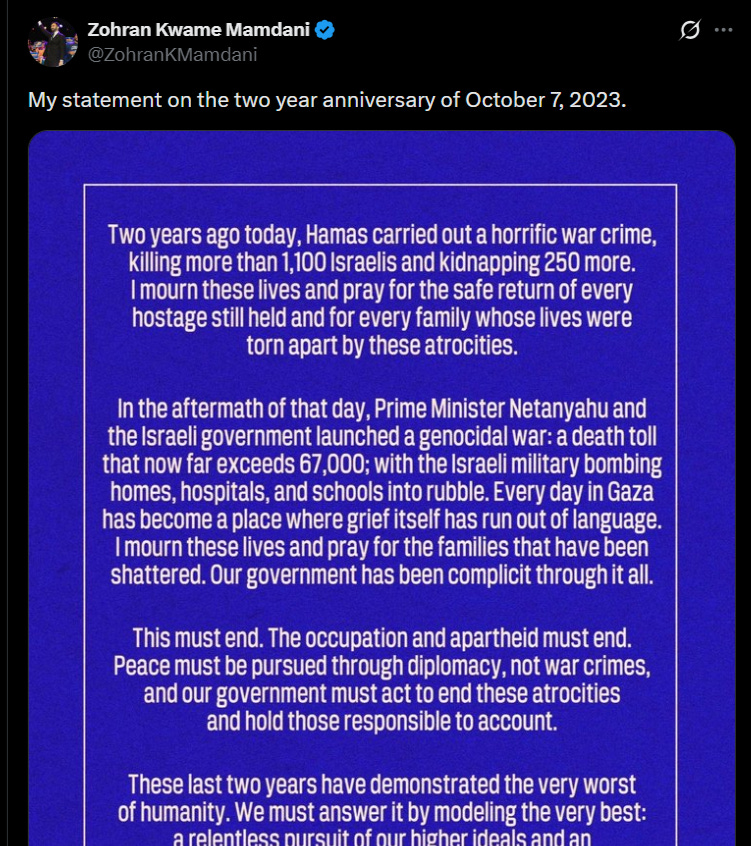
He is also doing atrocity propaganda by describing resistance as a “horrific war crime,” repeating inflated or disputed casualty figures, and referring to occupying soldiers as “hostages”. This is an imperial narrative that criminalizes Palestinian resistance while normalizing occupation. These facts matter not only for historical truth, but because language determines political meaning. When resistance is framed as inherent atrocity and the occupying power is treated as the default legitimate actor, the structure of settler colonialism disappears from view. Being pro-Palestinian requires rejecting the discourses that criminalize resistance and sanitize occupation. When a politician accepts those discourses, they are not standing with Palestine; they are translating Palestinian suffering into a language the empire finds acceptable.
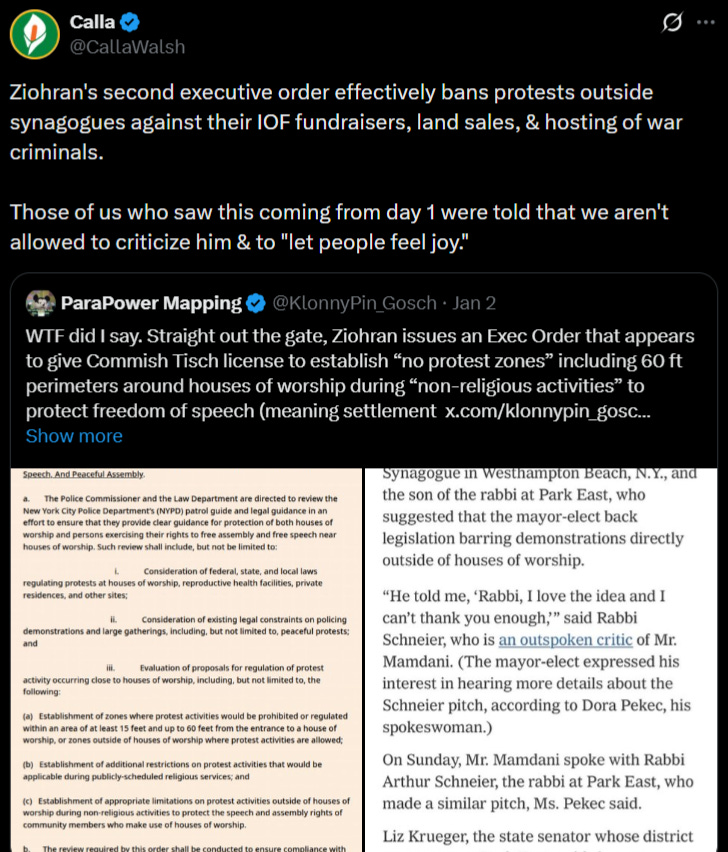
He also suppressed anti-genocide actions within forty-eight hours of becoming mayor.
Venezuela & Echoing Imperial Narratives
The U.S. has now launched military strikes inside Venezuela, with explosions reported in and around Caracas and other regions. This escalation does not emerge in a vacuum. It is the outcome of years of narrative preparation, language deployed to make aggression appear inevitable, even justified. In this context, Zohran Mamdani had claimed earlier that Nicolás Maduro and Miguel Díaz-Canel are “dictators suppressing a free and fair press” . This framing is lifted directly from the standard U.S. regime-change script. More importantly, this rhetoric sanitizes Washington’s illegal sanctions regime, which has inflicted devastating harm on Venezuelan society—crippling access to food, medicine, infrastructure, and basic survival. These sanctions are not passive policy tools; they are acts of collective punishment. By repeating imperial talking points while ignoring this reality, Mamdani helped obscure the violence already being carried out long before bombs fell.
The Material Foundation: Superprofits & The Labor Aristocracy
U.S. imperialism is not sustained by ideology alone, nor by military power in isolation. Its foundation is material. At its core are superprofits: extraordinary profits extracted from the Global South through the systematic underpayment of labor relative to the value it produces. These superprofits are not accidental distortions of capitalism; they are structural to imperialism itself. Without them, the economic and political stability of the imperial core would be impossible. This material reality gives rise to the labor aristocracy. This is not merely a segment of workers who happen to live better than others. Its relative comfort is inseparable from the continued exploitation of the Global South. Its standard of living depends on imperial flows of value, and this dependence shapes its political outlook. Because its material security is tied to the preservation of imperial structures, its political imagination is constrained. It does not seek the abolition of imperialism, but its reform—its management in a more humane, orderly, or ethical form.
Reformism as Imperial Management
For this reason, the labor aristocracy does not simply benefit passively from empire; it becomes empire’s social base. It supplies the mass support for reformist politics that promise gains without rupture. Social democracy, progressive electoralism, and liberal reformism flourish in the imperial core not because they represent universal paths to justice, but because they align with the interests of a class whose stability rests on global domination. These currents consistently offer redistribution without expropriation, justice without confrontation, and change without threatening the foundations of empire. They present themselves as pragmatic and responsible, while portraying revolutionary and anti-imperialist politics as extreme, unrealistic, or dangerous. The marginalization of genuine anti-imperialist struggle is therefore not primarily ideological it is structural. As long as superprofits continue to flow from the Global South to the imperial center, reformism will remain materially favored. Movements that challenge imperialism at its roots will continue to face repression, criminalization, and isolation not because they are impractical, but because they threaten the mechanisms that secure comfort and consent in the imperial core. Imperialist accumulation operates through unequal exchange, resource extraction, debt regimes, and coercive political arrangements that suppress wages and labor power across much of the Global South. A left that refuses to confront these realities is not a left at all it is a domestic management strategy for empire.